
My story
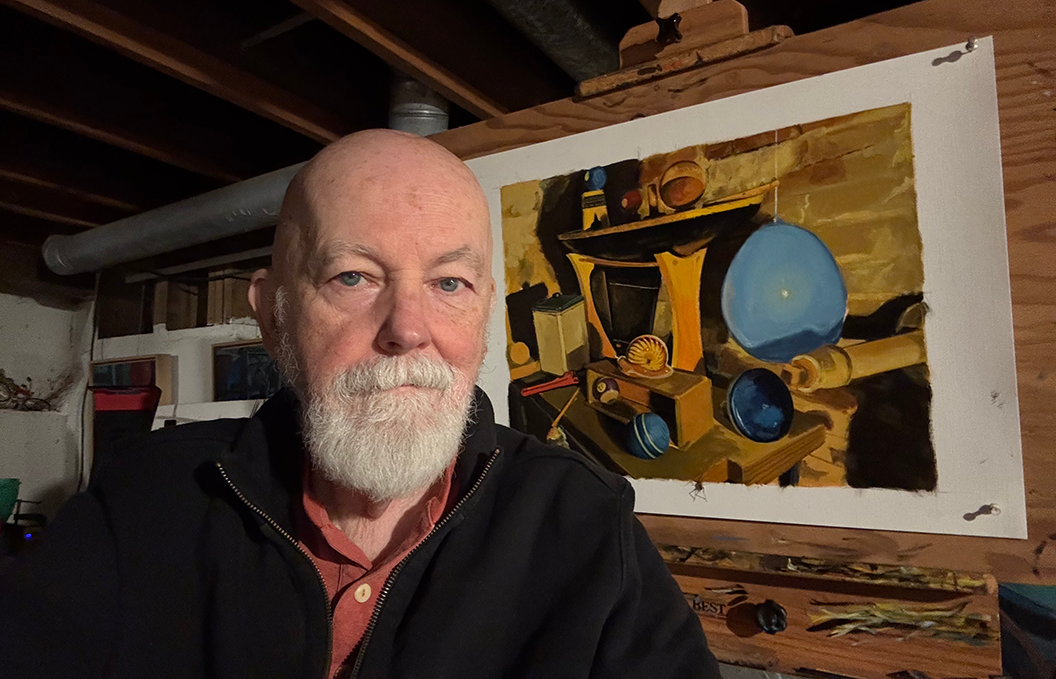
Based in central New Jersey, I've spent the last several years creating colorful still-life paintings that merge painterly realism with abstraction. Drawing from both representational and abstract traditions, my work highlights the overlooked beauty of utilitarian objects such as antique toys, hand tools, balloons and ephemera. In a world shaped by rapidly-changing technology and high-gloss consumerism, my paintings invite reflection on the commonplace objects that quietly inform our daily lives. The inclusion of antique tools and toys encourage reflection on the continuous passage of time, and thoughtful contemplation of our own place in this world.
How it started for me...
My fascination with making art dates back to my grammar school days, when I would amuse myself by creating my own versions of the popular newspaper comics of the day. It continued into high school, where I was exposed to ceramics and sculpture, which eventually led me to enroll in college. There, I gained experience in both printmaking and painting, along with exposure to the contemporary art world — specifically, the New York art word — in general.
My undergraduate years found me studying with some truly wonderful teachers, including Mel Leipzig and Frank Rivera at Mercer County College; along with Philip Pearlstein, Lois Dodd, and Sam Gelber at Brooklyn College, where I completed my undergraduate studies and eventually earned my MFA degree.
My earliest paintings were primarily large-scale figures in interior settings… emulation, no doubt, of the works of Leipzig and Pearlstein, both of whom had had a profound influence on my work. But it wasn’t until my graduate years that I connected with a sculpture teacher at Brooklyn, Al Terris, who encouraged me to find my own artistic voice. That encouragement led me to a focus on large-scale narrative painting, one that I pursued for the next several years. My work became looser, more colorful, and more intellectually satisfying. I continued on this path, producing a series of large-scale figures — in varying states of undress — in interior settings. These works frequently incorporated theatrical lighting and suggested underlying narratives that I left for the viewer to decipher. I continued along those lines for the next several years.
In 1990, I had gotten married, started a family, and had begun a new job, leaving little time for painting. So, following a one-person show I had in 1991 at Rider University in Lawrenceville, NJ, I basically hung-up my brushes. And I didn’t paint again for nearly 20 years! In 2010, I had received an invitation to participate in a 30th Anniversary exhibit at Blue Mountain Gallery in NYC, where I had had several one-person exhibits in the 1980s. Not having any “recent” work to display in the show, I took the invitation as a motivator, and set out to make my first painting in nearly two decades! Fortunately, it was like riding a bike... I picked-up right where I had left off in ’91, and was once again determined to create a new body of work.
At this point, I no longer had access to a studio, and wound-up using a portion of the basement in the 18th century farmhouse that was now my home. The cramped, cold quarters were not conducive to having models pose for me, so I gravitated toward still-life, a direction that I had actually begun around 1988. A treasure trove of antique toys, machines, and hand tools were still in the house from when I moved in, and they would, going forward, become the primary subjects of my work.
In the mid ‘80s, I had been teaching painting at Artworks in Trenton, to a mix of students who ranged from experienced professionals to rank beginners. One of the challenges I had – particularly with beginning students – was that many of them would tend to draw what they thought they saw, as opposed to what they actually saw. For example, if there was a chair on the floor, the students knew intuitively that the chair had four legs and they would tend to render them all, even if they were only able to see two or three of them. Accurately depicting color and tonal values also presented a problem for many. For example, if a student saw a white drape in a still-life set up, they would bring out all their white paint, even if the white cloth wasn’t actually “white“ at all… It might have a reflected color — say, blue or green — from a nearby object. Nonetheless, the student would attempt to render it using mostly white. This, too, was a common problem with my students.
“The deeper I got into this approach, the more I began to contemplate the unique histories of the individual objects I had been collecting. I began to view them not just as compositional tools, but also pondered the life they had had before coming into my possession.”
To address this challenge, I began to create very elaborate still-life arrangements designed to disrupt this way of thinking. I brought in unusual objects for which the students would not have a prior visual point of reference. Or, I would take familiar objects, and arrange them in unfamiliar ways. For example, I might use wire to suspend a chair from a ceiling, albeit upside down. This would mean that they could no longer draw based on what they knew about the chair; instead they would need to really look at the chair in order to understand what was actually going on. And since rendering color posed similar challenges to many, I began to bring in colored spotlights to illuminate portions of the still life. Under a green light, for example, that white drape was no longer white; it was now green!
These exercises were designed to get people to stop looking through the filter of their mind, and start seeing with their eyes. After doing a couple of in-class demonstrations to better illustrate these concepts, I became intrigued and began to incorporate similar concepts into my own paintings; first, in large-scale figure paintings, and then later, with the smaller still-life paintings that I had begun to do. Over time, this evolved, and once I resumed painting again in 2010, I leaned heavily into this concept and began acquiring and incorporating more and more unusual objects, both as a way to create visual interest, and to help emphasize the illusion of space in my compositions.
The deeper I got into this approach, the more I began to contemplate the unique histories of the individual objects I had been collecting. I began to view them not just as compositional tools, but also pondered the life they had had before coming into my possession. Who had used them in the past, and for what purpose? Was it a toy that a child played with in the 1930s? Or perhaps a hand tool that someone had used to fabricate a crib for a family’s newborn baby? The imagined memories associated with each individual object took on a new significance for me, and began to inform my collecting of “new” objects for my arrangements.
Now, more than 50 years after I started my artistic journey, I continue to be fascinated by the little discoveries I make with each painting. And those discoveries continue, even long after I’ve completed the painting. And that continues to keep painting fresh – and meaningful – for me!